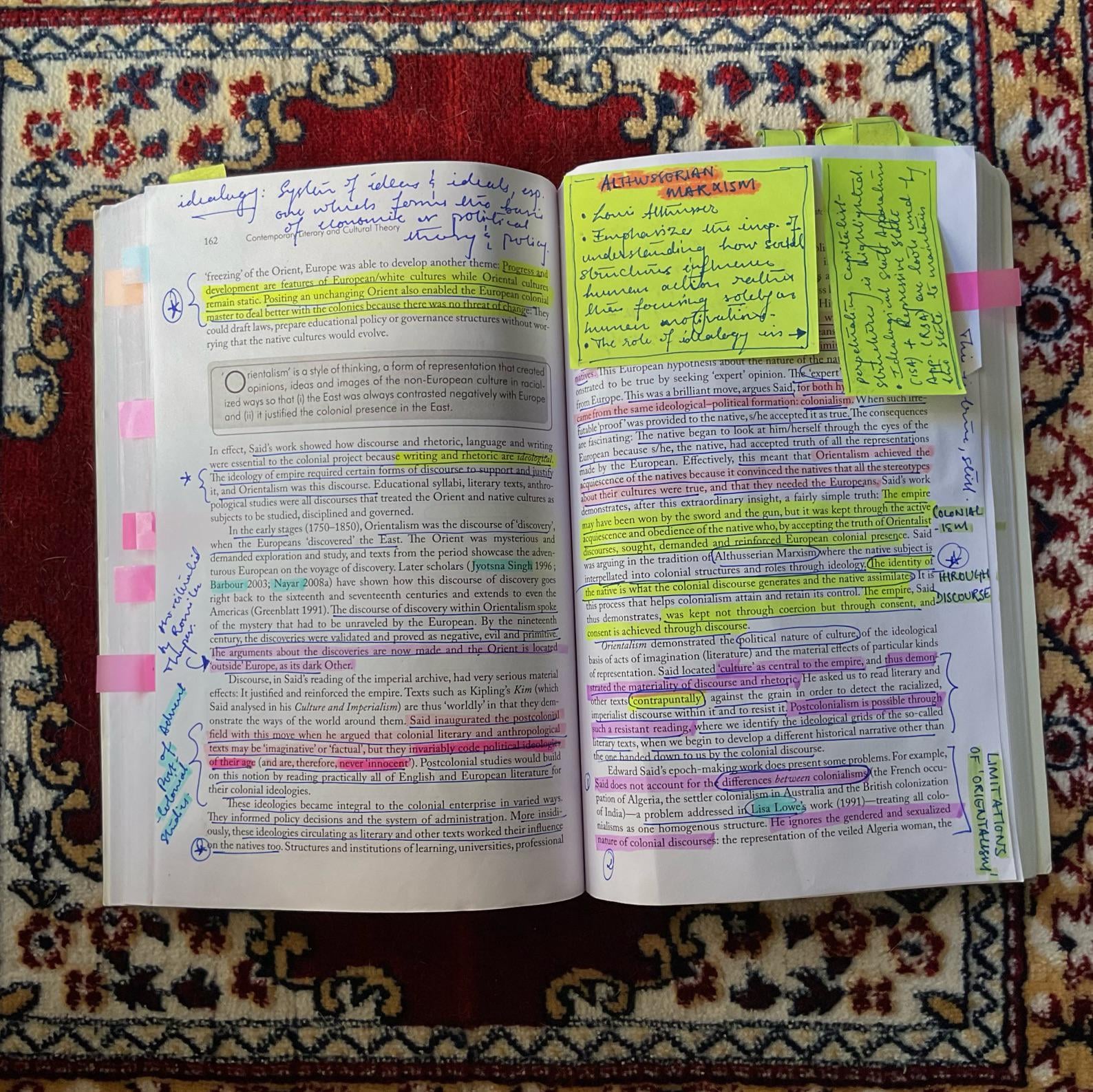

Textbook highlights in the age of AI
Many students already have a way to mark what matters: a line under a sentence, a bright strip of color beside a definition, a note in the margin. Those marks make a textbook feel personal. They point back to the exact place where an idea caught your attention, and they make it easier to find that passage when you return to the page.
But finding a sentence again is only the first step. What makes a highlight useful for learning is what you do with it next.
A highlight is a bookmark for your thinking
Highlighting is popular, but a colored sentence by itself does not guarantee understanding. Dunlosky and colleagues’ review of common study techniques rated highlighting and underlining as low utility when used on their own. Students may mark too much, or mark a sentence without processing what it means. The review also points toward a practical opportunity: help readers use their marks more deliberately. (Dunlosky et al., Psychological Science in the Public Interest, 2013)
The useful role of a highlight is to preserve a learner’s choice: this definition, claim, diagram caption, or confusing paragraph deserves another look. The mark keeps your attention anchored to the author’s words. It is a bookmark for a question, not proof that the idea has been learned.
Ask the passage a better question
Once a passage is marked, make your uncertainty specific: “What does this term mean here?” “Can you give me an example?” “Why does this step follow?” If you are studying with a tutor or an AI tool, use the conversation to work through that question, then compare the explanation with the highlighted source. If an answer sounds plausible but does not fit the text, return to the author’s words.
This matters because a good study interaction does more than make text shorter. In a small study of students learning about the circulatory system, Chi and colleagues found greater gains when students explained ideas to themselves while reading than when they reread the text. That study tested self-explanation, not AI tutoring, but it suggests a useful habit: put the connection into your own words and notice where your explanation breaks down. (Chi et al., Cognitive Science, 1994)
After reading an explanation, close it and say what the sentence means in your own words. If you cannot yet explain it, identify the missing step and ask about that. A conversation is most useful when it helps you form your own answer, not when it gives you more words to passively reread.
Turn the mark into a study loop
After an explanation, try recalling the idea without looking. A quiz based on the selected passage gives you a small chance to retrieve it. Research on retrieval practice has found better delayed retention from testing than from rereading alone in specific study settings; it does not mean every quiz or AI-generated question will work equally well. (Roediger & Karpicke, Psychological Science, 2006)
A simple loop is enough: mark a short passage, write or ask a question about it, explain the idea in your own words, and check what you can recall later. When you review, keep your note close to the original text. That way the highlight remains a path back into the book rather than a detached list of lines.
What this research tells us—and what it doesn’t
The research above supports practices such as self-explanation and retrieval practice; it does not establish that AI-generated explanations improve learning outcomes. Winchell, Lan, and Mozer found that students’ highlighting patterns could help predict comprehension and interests in their study. Prediction is not proof that highlighting caused better learning, either. (Winchell et al., Cognitive Science, 2020)
The value is in the routine around the mark: choose a passage, make sense of it, and return later to see what you can recall.
How Reader++ handles highlights
Reader++ keeps saved explanations and summaries attached to the passage they came from, where you can reopen them and ask follow-up questions.